

eLearning Recruiters in EMEA: Connecting EdTech Companies with Commercial Talent
Finding the right talent in EdTech and eLearning takes more than matching skills to job descriptions. RecruitHer, led by founder Emilia Kruszewska, specialises in mid to senior level commercial recruitment across EMEA, with a focus on the UK, Germany and the Nordics. Discover how sector knowledge, established industry relationships and a targeted recruitment approach help learning technology companies reduce ramp time and build stronger teams.

How to interview for an EdTech Account Executive role in Barcelona
A Barcelona focused EdTech Account Executive interview guide covering full cycle new business sales, international territories, early stage selling, sales metrics, concise interview answers, commercial questions and salary context.

How to succeed in a Stockholm EdTech Account Executive interview
A Stockholm focused guide to EdTech Account Executive interviews covering new business ownership, school and municipality sales, full cycle selling, numbers, concise interview communication, commercial questions and salary signals.

Should an EdTech startup use retained or contingency recruitment?
Retained and contingency recruitment solve different hiring problems. This guide explains when an EdTech startup should use each model and why senior searches often benefit from exclusivity and deeper market mapping.

From Teacher to EdTech: A Job Search Success Story
Moving from teaching into EdTech can feel difficult, especially when applications don’t lead anywhere. This success story shows how one teacher used focused applications, proactive outreach and conversations with people across the sector to build clarity, create opportunities and secure two job offers within around three months.

What does an EdTech recruitment agency cost?
UK recruitment fees for permanent hires are commonly charged as a percentage of base salary. This guide explains the typical range, what changes the fee and why companies should compare the service as well as the headline percentage.

How long does it take to recruit a Head of Sales in EdTech?
A Head of Sales search usually takes longer than an individual sales hire because the pool is smaller and the decision carries more risk. This guide shows a realistic process from brief to accepted offer and the common delays EdTech companies can avoid.

Should an EdTech salesperson already have education experience?
Education experience can be a major advantage in EdTech sales, but it is not always essential. The right answer depends on the customer, product, sales cycle and the gaps already inside your team.

How do I hire a good EdTech salesperson?
Hiring a good EdTech salesperson starts with the sale you need them to make, not a generic list of sector experience. This guide explains what to test, which evidence matters and how to avoid creating a job description for a commercial unicorn.

EdTech careers in Germany: where should you look and why does localisation matter?
Germany has a diverse EdTech market spanning startups, learning platforms, corporate learning and major education publishers. This guide looks at key cities and employers, the roles available, and why companies expanding into Germany need to think beyond translation to curriculum, GDPR, local buying structures and genuine market understanding.

What should EdTech startups budget for a Head of Sales in 2027?
It is too early to report observed 2027 salaries, but companies can already plan using current UK EdTech vacancies. This guide uses 2026 advertised roles to show how scope, stage and seniority should shape a 2027 Head of Sales budget.

EdTech talks about engagement. But who gets to engage?
EdTech promises personalisation, engagement and better outcomes, but those promises only work when products recognise individual learner needs. This article looks at assistive technology, neurodiversity and learner variability, and explains why educators and learners need a real role in co creating inclusive EdTech.

Want better product market fit? Stop building EdTech without educators.
Product market fit in EdTech is unusually complex because the buyer, user and learner are often different people. This article argues that co creation helps startups and scaleups understand real problems earlier, build products that fit education settings better and improve adoption, retention and long term growth.

Attracting EdTech talent at every stage of growth
The talent an EdTech startup needs can look very different from the talent required by a scaleup or established company. This article explores how hiring needs, candidate motivations and employer propositions change as companies grow. It covers startup builders, scaleup operators, experienced talent, flexibility, leadership, progression and why companies need to be honest about the environment candidates are actually joining.

What do EdTech sales job descriptions get wrong?
EdTech sales job descriptions often mix genuine requirements with habits, preferences and an idealised CV. This guide shows what to keep, what to challenge and how to widen the pool without lowering standards.

EdTech Recruitment Agency
Finding the right people in EdTech requires more than matching job titles to CVs. This guide explains how specialist EdTech recruitment works, who RecruitHer recruits for, the roles and markets we cover, and how hiring needs differ between startups, scaleups and established organisations. It also explores recruitment models, candidate experience, flexible working, transferable education experience and RecruitHer’s Talent Ecosystem approach.

Should EdTech companies hire from Edu or EdTech talent
EdTech companies often take one of two approaches to hiring: recruit strong tech talent and teach them education, or prioritise people who already understand the sector. This article explores why the strongest approach is usually somewhere in the middle.

Applying for EdTech jobs in the age of AI: why being generic can make you invisible
AI is changing how EdTech recruiters search for and assess candidates. But while many job seekers are making their profiles broader to keep their options open, this can make them harder to find. This article explains why specific skills, sector experience, results and relevant terminology matter, and how to make your CV and LinkedIn profile work better for both AI tools and human recruiters.

How to Tailor Your CV for EdTech roles
Tailoring your CV doesn’t mean rewriting it for every job. It means making the right evidence easier to see. This post explains how EdTech professionals can show stronger alignment with a role by prioritising relevant experience, using clear sector language and giving hiring managers enough detail to assess fit without guesswork.
Live CV, LinkedIn and interview support for job seekers in EdTech sector
The RecruitHer Career Drop In is a practical session for EdTech professionals and people moving from education into EdTech. Bring questions about your CV, LinkedIn, applications, career positioning or interviews and get clear feedback to help you take your next step.

Why I Became a Mentor at SuperCharger Ventures
Hiring at the wrong time or for the wrong role can slow an EdTech startup down. This post explains how better workforce planning helps founders decide who to hire next, attract the right talent and build teams that support sustainable growth, including my work as a mentor with SuperCharger Ventures.

How to Build an Outbound Sales Pipeline into Multi Academy Trusts with a great sales person
Selling into Multi Academy Trusts takes more than more calls and emails. This guide explains how strong EdTech salespeople plan accounts, map buying committees, build better data and use timing, trust and customer insight to create a stronger sales pipeline.

Hiring founding Business Salespeople in EdTech: Account Executive, Business Development Manager or Sales Manager?
EdTech sales job titles often hide very different responsibilities. This guide explains the difference between Account Executives, Business Development Managers and Sales Managers, helping leaders define the right role, assess candidates and hire for the work their business needs.

Hiring Your First Salesperson in EdTech: What Founders Need to Get Right
Hiring your first salesperson is a major step for an EdTech company, but success depends on more than finding a strong CV. This guide explains how to define the role, assess relevant experience, offer realistic pay and give your new hire the support needed to build repeatable growth.
Moving From Teaching Into EdTech: Six Roles Explained
Thinking about moving from teaching into EdTech but confused by the job titles? This post explains six common EdTech roles, how teaching skills transfer, what employers look for, and how the EdTech Career Map for Teachers can help you plan your next step.

Growth Stage vs Scale Up Stage
This post explores the difference between growing and scaling an EdTech company, from longer sales cycles and changing funding conditions to recruitment, leadership and the need for relevant stage experience. It looks at what companies may be going through as they move from proving demand to building a business that can grow sustainably.

Salary Negotiation With a New Hire: Why Leaving It Until the End Can Cost You the Right Candidate
Salary negotiation should not be left until the final offer stage. This post explains why late salary conversations can damage trust, waste time and cause strong candidates to drop out. It covers why employers should be clearer about salary ranges earlier in the process, how to handle negotiation fairly, why gender can shape negotiation outcomes, and how to balance flexibility with internal equity. The post also shares best practice for salary discussions in sales roles where base salary, commission, OTE and targets all matter.

How to Interview Candidates After CV Screening
Once candidates have been shortlisted from CV screening, employers need a clear interview process to assess fit properly. This post explains how to structure the next stages, starting with a 15 minute intro call to understand motivation, personality and basic alignment. It then covers deeper hiring manager interviews, how to use the STAR method, what to ask sales candidates, how to assess the first 30, 60 and 90 days, and when to involve senior stakeholders or wider team members. The focus is on helping employers make clearer, faster and more confident hiring decisions.
Generalist recruitment starts with the job title. Specialist recruitment starts with the problem.
Job titles are useful, but they are often too blunt for specialist sectors like education and edtech. This post explains why generalist recruitment often starts with the job title, while specialist recruitment starts with the problem the hire needs to solve. It uses research on skills based hiring, talent pools and the cost of poor hiring to show why sector context matters when hiring for edtech, education, higher education and adjacent markets.
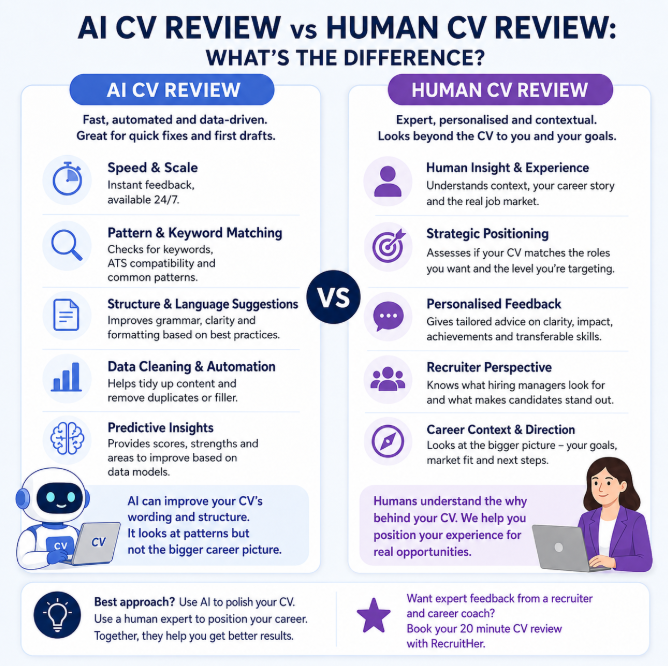
CV Review AI vs Human: What’s the Difference?
AI CV review tools can be useful for quick edits, grammar checks, formatting, and keyword suggestions. But they often miss the bigger issue: whether your CV is positioned clearly for the roles you want. This post explains the difference between having your CV reviewed by AI and by a recruiter and career coach. It covers what each option can do, where free CV reviews may fall short, and why expert human feedback can help you understand how your CV is really landing with hiring managers.

Why Retained Recruitment Works Better for Specialised EdTech Hiring
Retained recruitment gives EdTech companies a more focused and strategic way to hire specialist talent. This post explains the difference between retained and contingent recruitment, why job adverts are often not enough for niche EdTech roles, and how RecruitHer works as a retained search partner to find candidates with the right sector knowledge, networks and ability to deliver results quickly.

How to Screen CVs When Everyone Sounds the Same
AI written CVs are becoming more common, making it harder for employers to identify the strongest candidates quickly. This post explains how hiring managers can improve CV screening by writing clearer job descriptions, looking beyond keywords, checking sector experience, reviewing past employers and roles, and spotting real evidence of impact. It also explores why human judgement still matters, especially when hiring for edtech, education, healthcare, public sector, and other relationship led sectors.

How RecruitHer Works With EdTech Organisations
RecruitHer partners with EdTech organisations to hire strong, diverse talent across commercial, go to market and leadership roles. This post explains how our recruitment process works, from the intake call and candidate brief to sourcing, screening, timelines, fees and ongoing support. It also shares why inclusive hiring matters in EdTech and how a thoughtful recruitment partner can help teams hire with more clarity and confidence.

Expert CV Review for Education and EdTech Professionals
AI tools and free CV reviews can help with wording, but they often miss the bigger issue: how your CV is actually read by a human. This post explains why an expert CV review matters, especially for education and edtech professionals moving into or within the sector. It covers the limits of AI feedback, what a recruiter led CV review includes, and how tailored advice can help you understand your positioning, improve clarity, and make stronger job applications.

Executive CV Writing for EdTech Product Leaders in EdTech
Product leaders in education and EdTech often need to balance learner needs, customer demands and commercial goals. This article explores why their full impact can be difficult to show on a CV and how a detailed executive CV process can uncover their leadership, sector knowledge and readiness for a more senior role.

When to hire your first salesperson for your EdTech?
Hiring your first salesperson can help an EdTech company grow, but hiring before the product, customer and sales process are clear can become costly. This guide explains why founders should lead early sales, how to recognise the right hiring moment, which sales role may suit the business and what systems, targets and support should be ready before the new person joins.

Why Hiring Product Talent in Education and EdTech Takes Time
Finding the right Product leader in education and EdTech often takes more than advertising a role. This article explores the challenges of hiring across higher education, K12 and further education, including complex job titles, passive candidates, high application volumes and the value of specialist retained search.

Executive CV Writing for Customer Success Leaders
Customer Success leaders often create significant commercial and strategic value, but their CVs can make their work sound mainly supportive. This article explores why their impact is difficult to explain and how a detailed executive CV process can uncover achievements, strengthen positioning and build confidence for senior applications and interviews.
Transitioning From Teaching: Best Roles Beyond the Classroom
Thinking about transitioning from teaching into another sector? This post explores some of the best roles for teachers leaving the classroom, explains how teaching skills transfer, and looks at why EdTech can be a strong next step.

Career transition support for EdTech and education teams navigating change
RecruitHer provides specialist outplacement support for organisations in EdTech and education. We help people affected by restructuring move forward with clearer career direction, stronger job search tools and practical support for their next step

Building the Interview Muscle: How to Prepare for Job Interviews
Getting an interview is only one part of the job search. This blog explains how to build your interview muscle, understand each interview stage, prepare the right examples and present your experience with more clarity and confidence.

Recruitment in UK EdTech: why specialist hiring matters
This blog explores the UK EdTech recruitment landscape, from K 12 and higher education to assessment, LMS, SIS, accessibility, AI in education and digital learning. It explains why specialist hiring matters, how the UK market is changing, and why RecruitHer was created to help education technology companies build stronger, fairer and more sector aware teams.

RecruitHer: EdTech Education Technology Recruitment Experts
RecruitHer supports scaling education technology companies with specialist hiring across EdTech, eLearning, assessment, digital transformation, accessibility, LMS, SIS, AI in education and wider learning technology. The blog explains why sector knowledge matters, how different EMEA markets shape hiring needs and how RecruitHer helps companies find talent that matches the role, culture, market and stage of growth.

How recruiters actually work
Recruitment can often seem mysterious, but understanding that recruiters are hired by companies to actively source and match talent can help candidates better navigate their job searches. While high application volumes sometimes lead to frustrating silences, a strong recruiter will transparently support your positioning and proactively connect you with the right opportunities. Ultimately, agencies like RecruitHer focus on championing diverse talent within the EdTech sector to ensure hiring is thoughtful, fair, and mutually beneficial.

Applying to more jobs will not increase your chances. Better positioning will.
Applying to more jobs is not always the answer. LAND helps experienced professionals understand what is not working in their job search, sharpen their CV, LinkedIn and interview positioning, and build a clearer strategy to secure more interviews.

Choosing the Best EdTech Recruitment Agency for Growth in 2026
Scaling an EdTech company means hiring people who understand both education and commercial growth. This post explains why specialist EdTech recruitment matters, what companies should expect from a strong talent partner, and how RecruitHer supports growing teams with focused, sector informed hiring.

EdTech recruitment in Belgium: why specialist hiring matters
Belgium is a digitally capable education technology market with strong public investment, active digital skills work and clear demand for STEM, ICT and teacher support solutions. This blog explores the Belgian EdTech landscape, the impact of teacher shortages, the country’s multilingual education system, digital competence needs and why specialist EdTech recruitment matters for companies scaling in Belgium and across Benelux.

Outplacement for EdTech
When valued people leave an EdTech company, how they are supported matters. This post explores why human led, sector specific outplacement helps departing employees find their next chapter with clarity, while helping companies protect trust, culture and reputation.

EdTech recruitment in the Netherlands: why specialist hiring matters
The Netherlands is a digitally mature education technology market where schools, universities and training providers expect quality, interoperability, evidence of impact and strong alignment with Dutch education values. This blog explores the Dutch EdTech landscape, useful ecosystem resources, how hiring differs across K 12, vocational education, higher education and corporate learning, and why specialist EdTech recruitment and EdTech sales recruitment matter for companies scaling in the Netherlands and across Europe.

EdTech recruitment in Finland: why specialist hiring matters
Finland is one of Europe’s most digitally skilled education technology markets, with high digital capability, strong public services and growing AI adoption. This blog explores the Finnish EdTech landscape, the role of AI, digital learning, Nordic growth, local hiring needs and why specialist EdTech recruitment matters for companies scaling in Finland and across Europe.

EdTech in emerging markets: why the right hire matters more than ever
The global EdTech market is growing quickly, driven by AI, personalised learning, digital skills, online learning and workforce training. But growth looks very different across countries. This blog explores what is happening in emerging and fast growing EdTech markets, why local context matters and why companies need the right people on the ground to build trust, partnerships and long term growth.

EdTech Recruitment in the UAE and Middle East: Hiring for AI and Digital Learning Growth
The UAE, and Dubai in particular, has become one of the most active education technology markets in the Middle East. Strong private school growth, government focus on AI, digital learning, future skills and the fast adoption of online learning during the pandemic have created a strong opening for EdTech companies. This blog explores why the UAE acts as an EdTech incubator for the region, how the Middle East education market is changing and why specialist EdTech recruitment matters for companies scaling across Dubai, the UAE and wider MENA.

University Redundancies: How Outplacement Supports Staff
When university staff face redundancy, they need more than generic career support. This post explores why human led outplacement, grounded in higher education sector knowledge, can help departing employees move forward with clarity, dignity and purpose. It also looks at how universities can protect trust, reputation and institutional values by supporting the people who helped build them.

EdTech recruitment in Ukraine: why specialist hiring matters
Ukraine is one of the most digitally resilient education technology markets in Europe, with strong digital public services, a highly skilled technology talent base and a clear need for practical digital education solutions. This blog explores Ukraine’s EdTech landscape, the role of digital learning during war, access, cybersecurity, reskilling, workforce transition and why specialist EdTech recruitment matters for companies scaling in Ukraine and across Europe.

How to Land Interviews in a Competitive Job Market in 2026
The 2026 job market is noisy, especially across EdTech and education. Companies are still hiring, but candidates are facing more competition, longer hiring processes, and a lot more noise. This article shares practical advice on how to position yourself clearly, tailor your CV, improve your LinkedIn profile, build relationships before you need them, and prepare for interviews with more confidence.

Why EdTech Hiring Needs More Than a Job Advert in 2026
The EdTech hiring market may look candidate heavy, but more applications do not always mean better hiring. Many hiring managers are receiving high volumes of CVs, yet only a small percentage are truly relevant. This article explains why relying only on job adverts can slow down the process, why sector knowledge matters, and how working with a specialist headhunter can help hiring teams cut through the noise, screen candidates properly, and reach the right people faster.

EdTech recruitment in Egypt: why specialist hiring matters
Egypt is one of the most important education technology markets in MENA and Africa, with a large education system, a young population, growing demand for affordable learning and a strong national focus on digital transformation, ICT skills and AI. This blog explores the Egyptian EdTech landscape, the role of access, affordability, teacher development and workforce readiness, and why specialist EdTech recruitment matters for companies scaling in Egypt and across the wider region.

EdTech recruitment in Spain: why specialist hiring matters
Spain is a strong market for education technology, eLearning and digital learning companies, with major investment in teacher digital skills, vocational education and digital capability. This blog explores the Spanish EdTech landscape, why hiring in Spain needs local and sector knowledge, how Spanish companies expand into Latin America, Europe, the UK and the US, and how RecruitHer supports companies with specialist EdTech recruitment and EdTech sales recruitment.

Why EdTech impact has moved from “nice to have” to “non negotiable”
EdTech impact is no longer a nice extra. Education institutions need evidence that products improve learning, save time, support staff, increase engagement, or create measurable value. This post explains why impact has become central to EdTech buying decisions, what types of impact companies should measure, the grey areas of proving outcomes, and how education institutions can verify whether a product truly works.

Why job titles matter when selling EdTech into education
Job titles matter when selling EdTech into education because they shape how buyers receive the first conversation. Schools, universities, and education providers often respond better to consultative titles that signal trust, understanding, and problem solving. This post explores why titles like Education Consultant, Learning Consultant, and Partnerships Manager can work better than traditional sales titles in education markets.

How to Apply for Sales Roles in EdTech and Get Interviews
Sales roles in EdTech are highly competitive, and generic CVs no longer work. This guide explains how to show clear impact, tailor your experience, and position yourself effectively to secure more interviews.

EdTech recruitment in Poland: why specialist hiring matters
Poland is a strong technology market with growing focus on digital skills, AI capability, STEM and ICT talent. This blog explores the Polish EdTech landscape, the role of digital skills, women in technology, employability, local hiring needs and why specialist EdTech recruitment matters for companies scaling in Poland and across Europe.

Why Working with a Specialist EdTech Recruiter?
Hiring in EdTech requires more than finding people with the right job title. It requires sector knowledge, understanding of education buyers, and access to talent that can operate across learning, technology, and commercial growth. This post explains why working with a specialist EdTech and eLearning recruitment agency can help companies hire faster, reduce noise, and find candidates who bring both skill and context.

EdTech recruitment in Italy: why specialist hiring matters
Italy is a digitally ambitious education technology market with strong infrastructure, growing AI investment and a major digital skills gap. This blog explores the Italian EdTech landscape, the role of digital capability, AI ready learning, local hiring needs and why specialist EdTech recruitment matters for companies scaling in Italy and across Europe.

EdTech recruitment in Ireland: why specialist hiring matters
Ireland is one of Europe’s most digitally capable education and technology markets, with strong school digitisation, high basic digital skills and active investment in cybersecurity, semiconductors and green digital tools. This blog explores the Irish EdTech landscape, the role of digital learning, AI, STEM, international growth and why specialist EdTech recruitment matters for companies scaling in Ireland and across Europe.

How to Fix Your LinkedIn Profile for a Career Move in EdTech in 2026
In a candidate heavy EdTech market, a strong LinkedIn profile is no longer optional. This guide shows mid to senior professionals how to position their experience, clarify their direction, and align their profile with what hiring managers are actually looking for. Focus is on impact, relevance, and clear positioning rather than generic personal branding.

Why professionals in higher education are starting to look beyond universities
More professionals in higher education are starting to question their long term career path as the sector faces funding pressure, slower progression, and increasing workloads. This article explores why many are considering a move, from outdated systems and limited flexibility to lower pay compared to commercial roles.

Why strong sales candidates still miss out on interviews
Many strong sales professionals miss out on interviews because their CV does not clearly show performance. This guide explains how to highlight quota, revenue, pipeline, and target markets in a way that hiring managers can quickly understand. Practical advice for account executives, BDMs, and partnerships leaders who want to stand out in a crowded market.

How to update your CV in 2026 and get more interviews
Most experienced candidates are not getting interviews because their CV does not reflect how hiring works today. This guide breaks down what to fix, from using metrics and outcomes to aligning with job descriptions and showing commercial impact. Clear, practical advice for professionals who want to stand out and get shortlisted.

Why Great Women Still Get Overlooked at Work
Many talented professionals are overlooked not because they lack experience, but because their impact is not clearly communicated. Research shows women are significantly less likely to self promote, which affects visibility, progression, and hiring outcomes. This post explores why that happens, how it shows up in CVs, interviews, and promotions, and what needs to change to make your value easier for hiring managers to recognise.

CV rewrite and revamp
Applying for jobs but not getting interviews? In today’s competitive market, a simple CV rewrite isn’t enough. This guide explains why most CVs fail, what hiring managers actually look for in 2026, and how a proper CV revamp can help you stand out and start getting responses.

7 Tips to Hire Top Go-To-Market Talent in EdTech (Especially Sales)
Hiring top go-to-market talent in EdTech is not about volume, it’s about relevance. The best sales professionals combine commercial skill with sector understanding, strong networks, and the ability to navigate complex buying environments. This guide outlines seven practical ways to identify and hire the right people to drive growth.

Recruitment in EdTech: Why Sector Understanding Matters More Than Ever
Recruitment in EdTech is not just about skills, it’s about sector understanding. Companies that hire talent with both commercial ability and education insight build stronger teams, improve product adoption, and scale more effectively. RecruitHer supports EdTech organisations by connecting them with sector-informed professionals who can deliver impact from day one.

Why You’re Not Getting Interviews, and Why a CV Audit Might Be the Fix
Applying for jobs but not getting interviews? The problem may not be your experience—it’s your CV. In this post, we break down why most CVs fail, how a CV audit helps, and why working with a recruiter gives you a real advantage.

Where to Find the Right Candidates in EdTech (Without Relying Only on Job Ads)
Finding the right candidates in EdTech requires more than posting job ads. The best talent often comes from passive networks, targeted search, and proactive outreach. This guide outlines seven effective ways to source high-quality candidates in a competitive market.

Thinking of leaving teaching this year?
Many teachers are considering leaving the classroom this year but jumping straight into job applications rarely works. This post breaks down three essential steps to make a successful transition by late summer or September. Get clear on your target role, learn the skills required, and position your experience in a way employers understand. Start now to give yourself the best chance of landing the right opportunity.

Beyond the Classroom: Where teachers and education professionals go next and what it really takes
Most education professionals don’t start from scratch when they leave. They move into roles like learning design, customer success, project management, and commercial positions where their existing skills already apply. The key is not retraining, but positioning their experience to align with what employers need.

EdTech recruitment in France: why specialist hiring matters
France is a well funded education technology market with strong digital infrastructure, national investment in AI and a clear education digitisation strategy. This blog explores the French EdTech landscape, the role of AI, digital skills, school ready tools, local hiring needs and why specialist EdTech recruitment matters for companies scaling in France and across Europe.

From the Classroom to Corporate: Teacher Ambassador Programmes
Struggling to transition from teaching to the corporate sector without prior experience? Learn how joining EdTech ambassador programmes and user research groups can give your CV the ultimate commercial boost and help you get noticed by hiring managers.

Why mid to senior professionals in higher education are some of the best hires in EdTech
Higher education professionals working in digital learning, transformation, and data roles are already operating in tech driven environments. Their experience managing platforms, stakeholders, and large scale systems translates directly into EdTech roles. The key challenge is not capability but positioning their experience for a faster, more commercial environment.

How to write a great CV/resume
Most educators and EdTech professionals don't lack experience; they lack clear positioning. Because hiring managers only spend seconds scanning applications, your skills must immediately translate into commercial impact. This post explores why generic CV rewrites fall short, how to strategically reframe your teaching or leadership experience for the EdTech market, and why a proactive "reverse recruitment" strategy is the key to bypassing crowded job boards and securing your next role.

What is reverse recruitment in EdTech
Reverse recruitment in EdTech is a proactive job search strategy that shifts the focus from applying to roles to creating opportunities. Instead of competing with hundreds of applicants, candidates identify target companies, position themselves clearly, and start conversations before roles are advertised. In a relationship driven sector like EdTech, this approach helps professionals move beyond crowded application funnels and gain earlier, more relevant access to opportunities.

Navigating the Changing international EdTech Landscape
The EdTech sector's growth is inherently slow due to complex, lengthy procurement cycles and slow adoption within education systems. This reality makes deep sector experience, such as that of Steve Whitley, founder of EdTech Consulting, essential for success. Key industry trends include prioritizing international expansion into markets like the Gulf states and Southeast Asia, which demands careful cultural adaptation of products to local norms. Furthermore, Artificial Intelligence is accelerating innovation, but only the AI-powered tools that genuinely improve learning or reduce teacher workload will succeed. Ultimately, navigating the intersection of technology, education, and policy for sustainable growth requires both innovation and experienced guidance.

How to Navigate a Job Search and Interview Process in EdTech
Job searching today requires more than sending applications. It demands focus, positioning, and a clear understanding of how hiring processes work. This guide breaks down each stage of the interview journey, from initial screening to final conversations, and explains what employers are really assessing. With practical insights and data backed context, it helps candidates approach interviews more strategically and communicate their value with confidence.

Top Career Resources for Ex-Teachers in 2026
Leaving teaching can feel overwhelming, but the right resources can make the process clearer and more effective. This guide outlines practical tools and platforms for ex-teachers in 2026, including job boards, networking opportunities, and strategies for positioning your experience. It highlights how to move beyond trial and error by focusing on clarity, targeted applications, and understanding how hiring works in EdTech and corporate environments.

Career Coach vs Career Consultant in EdTech
Career coaches and career consultants play different but complementary roles, especially for professionals moving from education into EdTech. While coaching focuses on clarity, confidence, and direction, consulting provides market insight, positioning, and practical strategy to secure roles. In a competitive, candidate-heavy market, understanding when to use each can significantly improve your chances of a successful transition.

Should I Hire a Career Coach as a Teacher?
Leaving teaching can feel overwhelming, especially in a competitive job market where applying alone rarely works. This post explores whether hiring a career coach is the right move for educators looking to transition into EdTech or more commercial roles. It breaks down common challenges teachers face, explains how coaching provides clarity and structure, and highlights the importance of working with someone who understands both education and hiring. With practical insights and real market perspective, it offers a clearer path from classroom to career transition.

7 steps to finding a role outside teaching
If you are ready to leave the classroom, the first step isn't rewriting your CV or mass-applying to jobs—it is getting completely clear on your positioning. This 7-step guide breaks down exactly how to audit your teaching experience, translate your highly valuable skills into corporate language, and strategically transition into the EdTech sector without the frustration of trial and error.

How to Translate Teachers’ Transferable Skills into Corporate Language
Many teachers struggle to transition into EdTech or corporate roles not because they lack experience, but because they don’t communicate it in a way hiring managers understand. This post breaks down how to identify, refine, and translate transferable skills into clear, relevant language that aligns with specific roles. It highlights common mistakes, explains how hiring managers assess candidates, and shows how tailored positioning can significantly improve your chances of securing interviews.

Navigating a Career Change from Teaching: Why Sector Insight Matters
Teachers increasingly seek career coaching when transitioning out of the classroom, yet not all coaching is equally effective. This article explores what makes a strong career coach for educators, highlighting the importance of sector expertise and recruiter insight. It outlines why many teachers struggle to position themselves in the job market and how targeted, informed support can bridge that gap, with a focus on EdTech career pathways.

WhatsApp Community for Teachers Leaving the Classroom
Thinking about leaving teaching but not sure what comes next? This WhatsApp community is designed for educators exploring careers beyond the classroom, with a focus on EdTech roles. Get daily job opportunities, insights into career paths, and guidance from a recruiter’s perspective to help you navigate your transition with clarity.

From Classroom to EdTech Consultant: A Career Transition Case Study
This case study explores the journey of a teacher who transitioned into the EdTech industry during the pandemic. After helping colleagues adapt to online teaching tools, she began consulting with schools on digital transformation before moving into a role with a leading EdTech organisation. Today, she works across the sector as a consultant, trainer, and advisor to education institutions and technology companies. Her story highlights how classroom experience can translate into impactful roles within the EdTech ecosystem.

The Difference Between Being Capable and Being Visible
Capability alone does not guarantee recognition. Research shows that professionals who are less likely to self promote are often underestimated, which impacts hiring, progression, and pay. This post explores the gap between being capable and being visible, what effective visibility looks like, and how to communicate your impact in a clear and credible way.

From Head Teacher to EdTech Project Manager: Laura’s Transition Story
Laura, a former head teacher in Birmingham, stepped away from school leadership during a difficult personal period and completed a project management course to explore new opportunities. After briefly working in the automotive sector, she realised her passion remained in education and transitioned into an EdTech organisation supporting higher education institutions. Today, Laura works as a project manager in EdTech, enjoys a flexible work environment, and earns £20K more than she did in school leadership.

7 EdTech Roles for Teachers Leaving the Classroom
Many teachers assume their only career path is staying in the classroom or moving into school leadership. In reality, EdTech companies actively hire educators because they understand curriculum, classrooms, and how schools make decisions. This guide explores seven roles teachers commonly transition into including instructional design, customer success, EdTech sales, curriculum management, and programme leadership. Each role includes typical responsibilities, why teachers are well suited, and expected salary ranges in the UK.

From Classroom to EdTech Customer Success: Paul’s Career Transition Story
This case study explores Paul’s journey from classroom teaching to EdTech customer success and account management. After collaborating with an EdTech company used in his school, he moved into curriculum development, training, onboarding, and account management roles. Within three years, he was promoted twice and increased his salary. Today, he is exploring the next stage of his career with support from RecruitHer.

Rebuilding Confidence During an EdTech Career Transition: Katie’s Story
Katie, a teacher based in London, spent nearly a year searching for opportunities beyond the classroom with little success. After starting career coaching with RecruitHer, she gained clarity on suitable EdTech roles, repositioned her CV to highlight transferable skills, and developed a more focused job search strategy. While her transition is still ongoing, the first month of coaching has already helped her rebuild confidence and momentum in her career journey.

Exploring New Career Paths Beyond the Classroom: Jenny’s Transition Story
Jenny, a teacher based in London, began exploring new career opportunities after experiencing burnout and limited progression within teaching. By attending networking events across multiple sectors, she discovered an interest in cybersecurity. After connecting with professionals who had made similar transitions, she enrolled in cybersecurity training and began applying her knowledge within her school. Jenny is now exploring pathways into the cybersecurity sector as she continues her transition journey.

Why a Generic CV Will Not Get you a job in 2026
Many teachers hoping to move into EdTech rewrite their CV once and send it to every role they apply for. In the current hiring market that approach rarely works. Employers receive hundreds of applications and expect candidates to clearly match the role they are hiring for. This article explains why a single CV is not effective, how job descriptions should guide your application, and why tailoring your experience for each role makes a significant difference. It also shares examples of how teaching skills can be positioned differently depending on the job you are applying for.

How to Talk About Your Achievements Without Feeling Like You’re Bragging
Many professionals struggle to talk about their achievements without feeling uncomfortable. Research shows women are significantly less likely to self promote, which can impact career progression. This post breaks down how to communicate your impact clearly using a simple structure, helping you stand out without sounding forced or performative.
