
Thank you! Your submission has been received!
Oops! Something went wrong while submitting the form.

A Barcelona focused EdTech Account Executive interview guide covering full cycle new business sales, international territories, early stage selling, sales metrics, concise interview answers, commercial questions and salary context.

A Stockholm focused guide to EdTech Account Executive interviews covering new business ownership, school and municipality sales, full cycle selling, numbers, concise interview communication, commercial questions and salary signals.

Moving from teaching into EdTech can feel difficult, especially when applications don’t lead anywhere. This success story shows how one teacher used focused applications, proactive outreach and conversations with people across the sector to build clarity, create opportunities and secure two job offers within around three months.

AI is changing how EdTech recruiters search for and assess candidates. But while many job seekers are making their profiles broader to keep their options open, this can make them harder to find. This article explains why specific skills, sector experience, results and relevant terminology matter, and how to make your CV and LinkedIn profile work better for both AI tools and human recruiters.

Tailoring your CV doesn’t mean rewriting it for every job. It means making the right evidence easier to see. This post explains how EdTech professionals can show stronger alignment with a role by prioritising relevant experience, using clear sector language and giving hiring managers enough detail to assess fit without guesswork.
The RecruitHer Career Drop In is a practical session for EdTech professionals and people moving from education into EdTech. Bring questions about your CV, LinkedIn, applications, career positioning or interviews and get clear feedback to help you take your next step.
Thinking about moving from teaching into EdTech but confused by the job titles? This post explains six common EdTech roles, how teaching skills transfer, what employers look for, and how the EdTech Career Map for Teachers can help you plan your next step.
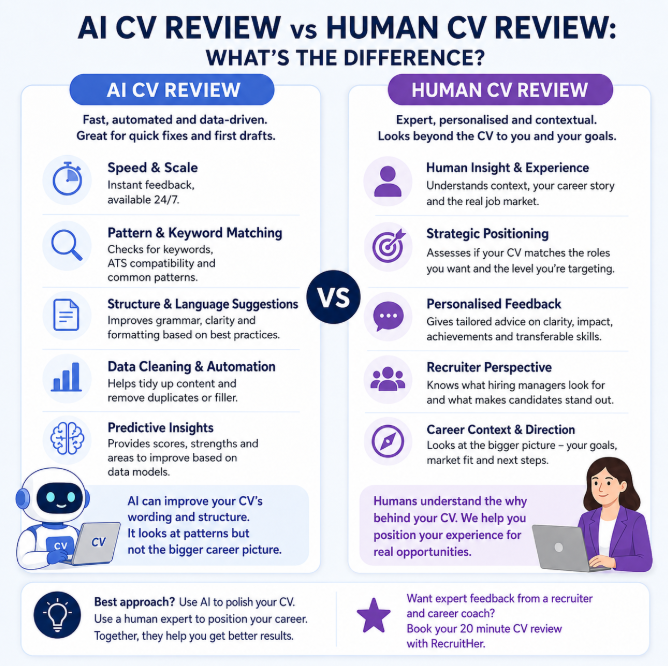
AI CV review tools can be useful for quick edits, grammar checks, formatting, and keyword suggestions. But they often miss the bigger issue: whether your CV is positioned clearly for the roles you want. This post explains the difference between having your CV reviewed by AI and by a recruiter and career coach. It covers what each option can do, where free CV reviews may fall short, and why expert human feedback can help you understand how your CV is really landing with hiring managers.

AI tools and free CV reviews can help with wording, but they often miss the bigger issue: how your CV is actually read by a human. This post explains why an expert CV review matters, especially for education and edtech professionals moving into or within the sector. It covers the limits of AI feedback, what a recruiter led CV review includes, and how tailored advice can help you understand your positioning, improve clarity, and make stronger job applications.

Product leaders in education and EdTech often need to balance learner needs, customer demands and commercial goals. This article explores why their full impact can be difficult to show on a CV and how a detailed executive CV process can uncover their leadership, sector knowledge and readiness for a more senior role.

Customer Success leaders often create significant commercial and strategic value, but their CVs can make their work sound mainly supportive. This article explores why their impact is difficult to explain and how a detailed executive CV process can uncover achievements, strengthen positioning and build confidence for senior applications and interviews.
Thinking about transitioning from teaching into another sector? This post explores some of the best roles for teachers leaving the classroom, explains how teaching skills transfer, and looks at why EdTech can be a strong next step.

Getting an interview is only one part of the job search. This blog explains how to build your interview muscle, understand each interview stage, prepare the right examples and present your experience with more clarity and confidence.

Recruitment can often seem mysterious, but understanding that recruiters are hired by companies to actively source and match talent can help candidates better navigate their job searches. While high application volumes sometimes lead to frustrating silences, a strong recruiter will transparently support your positioning and proactively connect you with the right opportunities. Ultimately, agencies like RecruitHer focus on championing diverse talent within the EdTech sector to ensure hiring is thoughtful, fair, and mutually beneficial.

Applying to more jobs is not always the answer. LAND helps experienced professionals understand what is not working in their job search, sharpen their CV, LinkedIn and interview positioning, and build a clearer strategy to secure more interviews.

The 2026 job market is noisy, especially across EdTech and education. Companies are still hiring, but candidates are facing more competition, longer hiring processes, and a lot more noise. This article shares practical advice on how to position yourself clearly, tailor your CV, improve your LinkedIn profile, build relationships before you need them, and prepare for interviews with more confidence.

Sales roles in EdTech are highly competitive, and generic CVs no longer work. This guide explains how to show clear impact, tailor your experience, and position yourself effectively to secure more interviews.

In a candidate heavy EdTech market, a strong LinkedIn profile is no longer optional. This guide shows mid to senior professionals how to position their experience, clarify their direction, and align their profile with what hiring managers are actually looking for. Focus is on impact, relevance, and clear positioning rather than generic personal branding.

More professionals in higher education are starting to question their long term career path as the sector faces funding pressure, slower progression, and increasing workloads. This article explores why many are considering a move, from outdated systems and limited flexibility to lower pay compared to commercial roles.

Many strong sales professionals miss out on interviews because their CV does not clearly show performance. This guide explains how to highlight quota, revenue, pipeline, and target markets in a way that hiring managers can quickly understand. Practical advice for account executives, BDMs, and partnerships leaders who want to stand out in a crowded market.

Most experienced candidates are not getting interviews because their CV does not reflect how hiring works today. This guide breaks down what to fix, from using metrics and outcomes to aligning with job descriptions and showing commercial impact. Clear, practical advice for professionals who want to stand out and get shortlisted.

Many talented professionals are overlooked not because they lack experience, but because their impact is not clearly communicated. Research shows women are significantly less likely to self promote, which affects visibility, progression, and hiring outcomes. This post explores why that happens, how it shows up in CVs, interviews, and promotions, and what needs to change to make your value easier for hiring managers to recognise.

Applying for jobs but not getting interviews? In today’s competitive market, a simple CV rewrite isn’t enough. This guide explains why most CVs fail, what hiring managers actually look for in 2026, and how a proper CV revamp can help you stand out and start getting responses.

Applying for jobs but not getting interviews? The problem may not be your experience—it’s your CV. In this post, we break down why most CVs fail, how a CV audit helps, and why working with a recruiter gives you a real advantage.

Many teachers are considering leaving the classroom this year but jumping straight into job applications rarely works. This post breaks down three essential steps to make a successful transition by late summer or September. Get clear on your target role, learn the skills required, and position your experience in a way employers understand. Start now to give yourself the best chance of landing the right opportunity.

Most education professionals don’t start from scratch when they leave. They move into roles like learning design, customer success, project management, and commercial positions where their existing skills already apply. The key is not retraining, but positioning their experience to align with what employers need.

Struggling to transition from teaching to the corporate sector without prior experience? Learn how joining EdTech ambassador programmes and user research groups can give your CV the ultimate commercial boost and help you get noticed by hiring managers.

Higher education professionals working in digital learning, transformation, and data roles are already operating in tech driven environments. Their experience managing platforms, stakeholders, and large scale systems translates directly into EdTech roles. The key challenge is not capability but positioning their experience for a faster, more commercial environment.

Most educators and EdTech professionals don't lack experience; they lack clear positioning. Because hiring managers only spend seconds scanning applications, your skills must immediately translate into commercial impact. This post explores why generic CV rewrites fall short, how to strategically reframe your teaching or leadership experience for the EdTech market, and why a proactive "reverse recruitment" strategy is the key to bypassing crowded job boards and securing your next role.

Reverse recruitment in EdTech is a proactive job search strategy that shifts the focus from applying to roles to creating opportunities. Instead of competing with hundreds of applicants, candidates identify target companies, position themselves clearly, and start conversations before roles are advertised. In a relationship driven sector like EdTech, this approach helps professionals move beyond crowded application funnels and gain earlier, more relevant access to opportunities.

Job searching today requires more than sending applications. It demands focus, positioning, and a clear understanding of how hiring processes work. This guide breaks down each stage of the interview journey, from initial screening to final conversations, and explains what employers are really assessing. With practical insights and data backed context, it helps candidates approach interviews more strategically and communicate their value with confidence.

Leaving teaching can feel overwhelming, but the right resources can make the process clearer and more effective. This guide outlines practical tools and platforms for ex-teachers in 2026, including job boards, networking opportunities, and strategies for positioning your experience. It highlights how to move beyond trial and error by focusing on clarity, targeted applications, and understanding how hiring works in EdTech and corporate environments.

Career coaches and career consultants play different but complementary roles, especially for professionals moving from education into EdTech. While coaching focuses on clarity, confidence, and direction, consulting provides market insight, positioning, and practical strategy to secure roles. In a competitive, candidate-heavy market, understanding when to use each can significantly improve your chances of a successful transition.

Leaving teaching can feel overwhelming, especially in a competitive job market where applying alone rarely works. This post explores whether hiring a career coach is the right move for educators looking to transition into EdTech or more commercial roles. It breaks down common challenges teachers face, explains how coaching provides clarity and structure, and highlights the importance of working with someone who understands both education and hiring. With practical insights and real market perspective, it offers a clearer path from classroom to career transition.

If you are ready to leave the classroom, the first step isn't rewriting your CV or mass-applying to jobs—it is getting completely clear on your positioning. This 7-step guide breaks down exactly how to audit your teaching experience, translate your highly valuable skills into corporate language, and strategically transition into the EdTech sector without the frustration of trial and error.

Many teachers struggle to transition into EdTech or corporate roles not because they lack experience, but because they don’t communicate it in a way hiring managers understand. This post breaks down how to identify, refine, and translate transferable skills into clear, relevant language that aligns with specific roles. It highlights common mistakes, explains how hiring managers assess candidates, and shows how tailored positioning can significantly improve your chances of securing interviews.

Teachers increasingly seek career coaching when transitioning out of the classroom, yet not all coaching is equally effective. This article explores what makes a strong career coach for educators, highlighting the importance of sector expertise and recruiter insight. It outlines why many teachers struggle to position themselves in the job market and how targeted, informed support can bridge that gap, with a focus on EdTech career pathways.

Many teachers assume their only career path is staying in the classroom or moving into school leadership. In reality, EdTech companies actively hire educators because they understand curriculum, classrooms, and how schools make decisions. This guide explores seven roles teachers commonly transition into including instructional design, customer success, EdTech sales, curriculum management, and programme leadership. Each role includes typical responsibilities, why teachers are well suited, and expected salary ranges in the UK.

Many teachers hoping to move into EdTech rewrite their CV once and send it to every role they apply for. In the current hiring market that approach rarely works. Employers receive hundreds of applications and expect candidates to clearly match the role they are hiring for. This article explains why a single CV is not effective, how job descriptions should guide your application, and why tailoring your experience for each role makes a significant difference. It also shares examples of how teaching skills can be positioned differently depending on the job you are applying for.

Many teachers are considering leaving the profession as workload and pressure increase. But the skills developed in the classroom are highly transferable. This article explores several career paths former teachers can pursue, from edtech and corporate training to project management and consulting, and how educators can successfully transition into new roles.

Teachers develop valuable transferable skills that are highly sought after beyond the classroom. This article explores the most common roles educators transition into, particularly within the EdTech sector. From customer success and training to curriculum design, sales and leadership roles, it highlights how teaching experience translates into corporate opportunities and provides insight into typical salary ranges and hiring processes.

Many teachers and senior leaders in education start their career transition by updating their CV or searching for jobs, but the most important first step happens before any application is sent. This article explores the psychological and practical barriers that often keep educators stuck in the “considering” stage for years. Drawing on research in career transition and behavioural science, it explains how identifying fears, uncertainty, and areas of discomfort can help educators make clearer decisions about whether to stay in the profession or explore new opportunities. Understanding these internal blockers is often the turning point that allows a career change to move from intention to action.

Many teachers looking to leave the classroom struggle to position their experience on a CV for roles outside education. In a candidate heavy job market, relevance matters more than ever. This article explains how teachers can translate their transferable skills, align their CV with job descriptions, highlight outcomes instead of responsibilities, and adapt their experience for roles such as curriculum designer, customer success manager, or account manager.

Across the EdTech sector, more senior female leaders are leaving permanent roles for the autonomy and flexibility of independent consulting and fractional leadership. However, stepping into an EdTech consultant role requires a fundamental shift in strategy. Success in this space depends on treating your personal brand as a business asset—meaning you must proactively build your market visibility, refine your commercial positioning, and showcase your expertise publicly long before you actually make the leap.

Looking for EdTech career coaching? RecruitHer offers outcome-focused career strategy for senior educators and professionals. Master your positioning today.

Transitioning from education into EdTech requires more than a polished CV. It demands clarity, positioning and market aligned strategy. This article explains how RecruitHer supports senior educators and EdTech professionals through structured career strategy, helping them refine their direction, strengthen their positioning and move closer to securing the right role.

Teachers exploring careers beyond the classroom often struggle to position their experience on LinkedIn. This article explains how to translate teaching responsibilities into skills employers recognise, highlight outcomes and achievements, and tailor your profile to the roles you want next. By focusing on transferable skills, relevant experience, and intentional networking, teachers can make LinkedIn a powerful tool during a career transition.

EdTech has evolved from basic classroom hardware to AI driven platforms that shape how schools, universities and employers deliver learning. Today’s ecosystem includes learning management systems, assessment tools, AI powered productivity platforms, accessibility software and immersive technologies. As the market matures, impact and evidence matter more than novelty. At the centre of it all are educators, whose classroom insight ensures technology genuinely improves learning rather than simply adding features.

More teachers across the UK are questioning whether they can continue working under increasing pressure and long hours. Many feel trapped, believing their experience only applies inside schools. This post explores why that belief is wrong, how teaching skills translate into education adjacent and corporate roles, and how structured guidance and career exploration can help educators move forward with clarity and confidence.

EdTech job searching goes far beyond LinkedIn. This article breaks down where EdTech companies actually advertise roles, from career pages and specialist job boards to recruiters and sector communities. It also explores the realities of a candidate heavy market, why roles move quickly, and how visibility, mindset, and understanding the hiring ecosystem can make a real difference as we move into 2026.

Moving from the classroom into EdTech is no longer unusual. Teachers and education professionals already hold deep sector knowledge that EdTech companies value. This post explores practical steps educators can take to transition into corporate roles, including upskilling, working with EdTech providers, leveraging ambassador programmes, and reframing transferable skills. It also shares real examples of educators who have successfully made the move and outlines how targeted support can make the transition clearer and more sustainable.

More educators are moving from classrooms into EdTech and corporate education roles. This post breaks down practical steps to make that transition smoother, from targeted upskilling and working with EdTech providers to understanding corporate roles, transferable skills, and how to position yourself for opportunities beyond the classroom.

EdTech is changing fast and so is hiring. For women and senior leaders, strong experience is no longer enough. This article explores why career coaching EdTech is changing fast and so is hiring. Your strong experience is no longer enough. This article explores why career coaching and sector specific mentoring help clarify positioning, stand out in a crowded market, and navigate job transitions with confidence. sector specific mentoring help clarify positioning, stand out in a crowded market, and navigate job transitions with confidence.

LinkedIn in 2026 is no longer a passive job search tool. It is a community and networking platform where visibility, familiarity, and human connection shape career opportunities. This article explains how recruiters and companies now use LinkedIn, why old application strategies no longer work, and how small, consistent interactions within your sector can help you build trust, stay visible, and become a recognised professional in a crowded market.

In 2026, the job market is more competitive than ever. A solid CV isn’t enough. This guide explores innovative ways to stand out—from value-led pitches and portfolios to visibility tactics and LinkedIn presence. Don’t just apply—position yourself for success.

The EdTech market is currently defined by high competition and overwhelmed hiring teams. In this environment, experience alone isn't enough; candidates need clarity, focus, and connection to stand out.

Most job seekers waste time tweaking bullets and headlines without knowing if their changes actually matter. In a competitive EdTech market, this uncertainty leads to lost momentum and burnout. Stop guessing and start treating support as a strategy, not a weakness.

Most CVs never reach a hiring manager because they aren’t ATS friendly. Here is how to make your document readable, searchable and aligned with what EdTech employers look for in 2026.

LinkedIn is where most hiring decisions start. If your profile isn’t clear, keyword rich and active, you get overlooked long before anyone opens your CV. This RecruitHer guide explains how to optimise your LinkedIn in 2026 so EdTech recruiters and hiring managers actually find you.

The EdTech market is currently crowded and competitive, and "applying and praying" is no longer a viable strategy. If you are sending out CVs and hearing silence, learn how to cut through the noise by moving beyond the application portal.

Most candidates blame the ATS when they get ghosted by their dream EdTech role. In reality, the system isn’t rejecting them. Their CV simply isn’t visible or clear enough for a recruiter to move them forward. This guide breaks down how ATS tools really work in EdTech, the myths slowing candidates down, and what to do to make sure your application stands out every time.

While the 'Easy Apply' button offers convenience, it often comes at the cost of visibility. In this post, we explore why hiring managers often prioritise direct applications over the "noise" of one-click candidates. Discover why taking the "harder" route allows you to showcase your specific sector experience and intention, drastically increasing your chances of landing an interview. Do less, better.

Most job seekers are rejected long before a hiring manager ever sees their CV. ATS filters out applications that lack the right language, tools or structure. The post includes practical steps and a full FAQ to help candidates get noticed.

The EdTech market is noisy. Stand out with a CV that works for ATS and humans, show your network, name the institutions you worked with, avoid Easy Apply, stay visible, and use your sector experience loudly. In EdTech, your contacts often matter more than your tasks.

This enterprise sales guide outlines the role of an Enterprise Account Executive in EdTech with a focus on the UK and London market. It covers key responsibilities, working arrangements, salary expectations, company expectations and candidate advice for success in complex, high‑value sales.

This post explores the Account Executive role in EdTech from a UK and London perspective, covering responsibilities, hybrid vs remote work, salary expectations, realistic timelines for results and guidance on managing internal expectations and stakeholder complexity.
%20Job%20in%20EdTech.png)
This blog post explores the Business Development Manager role in EdTech with a London and UK focus. It covers key responsibilities, salary benchmarks, career progression, required skills and what makes candidates stand out in this strategic commercial position.
.png)
A growing network for women in education, tech, data, and AI — to connect, collaborate, and shape the future of learning together.
.png)
Explore go-to-market careers in cybersecurity for the education sector, from marketing and product marketing to sales and customer success. Learn required skills, transferable experience from EdTech, salaries, and training options.
%20Job%20in%20EdTech.png)
The Sales Development Representative is a foundational commercial role in the EdTech sector. This blog unpacks what makes a great SDR in the UK, especially in London, including typical responsibilities, salary benchmarks, and how to navigate remote, hybrid and office-based setups. Whether you’re transitioning from teaching or customer service, or already in tech sales, this is your roadmap to SDR success in EdTech.

Upskilling is the most direct and crucial step for edu professionals transitioning into the EdTech field. Your pedagogical knowledge is your most valuable asset, and upskilling gives you the technical and business-oriented skills to apply that knowledge in a new context.

This guide outlines the key differences teachers need to understand when transitioning from the classroom to an edtech role like Curriculum Designer.

Former edu professionals excel in EdTech sales & client roles. Learn how to leverage your edu experience in account management, SDR, and customer success—with data-backed transferable skills.
