


Thank you! Your submission has been received!
Oops! Something went wrong while submitting the form.
EdTech recruitment is more complicated than matching a job title to a CV.
A Customer Success Manager joining a school technology company may need to understand why a teacher who loved the product in a demo struggles to use it with 30 pupils on a Tuesday morning. A salesperson selling into multi academy trusts needs to understand a buying process that can involve curriculum, finance, IT, safeguarding and senior leadership. A Head of Sales joining a ten person startup may need to build the sales process as well as manage it, while the same title inside an established education publisher could involve leading a sizeable team across multiple products and customer segments.
Those differences are why specialist EdTech recruitment matters.
At RecruitHer, we work across the intersection of education, technology and talent. We support EdTech businesses, education software companies, learning organisations and publishers with the people they need to grow, serve customers and strengthen their teams.
Our approach starts with understanding the business rather than simply taking a vacancy and searching for people with the same job title.
That matters in a market where finding the right talent remains difficult. The CIPD's UK Resourcing and Talent Planning research found that 64% of organisations that had tried to recruit experienced difficulty attracting candidates, while 69% said competition for well qualified talent had increased. It also found that 41% of organisations had experienced at least some new recruits leaving within their first 12 weeks.
Hiring is therefore not only about finding someone.
It is about finding someone who understands the opportunity, matches the environment and has a realistic reason to stay.
RecruitHer works with organisations across the wider EdTech and learning market.
Some are early stage companies building their first commercial teams. Others are scaleups expanding customer success, sales, partnerships or marketing. We also work with established EdTech businesses and organisations whose history sits in education publishing, training or learning rather than technology startups.
That distinction is important because the EdTech market has become much wider than businesses that actually describe themselves as "EdTech".
The Department for Education's latest assessment of the EdTech market in England, published in 2026, looks at a broad market of suppliers, products and services supporting technology use within education.
Within that wider ecosystem you will find school software, assessment platforms, digital curriculum businesses, education publishers, AI products, learning management systems, workplace learning, apprenticeship technology, higher education platforms, teacher technology, language learning, tutoring, professional learning and businesses providing infrastructure or services into education.
The recruitment needs across those organisations can be very different.
A learning platform selling directly to consumers does not necessarily need the same commercial experience as a company selling enterprise software to universities. A business selling safeguarding software to schools will need people who understand a different customer problem from a company providing corporate language learning.
A specialist recruitment process needs to understand those differences rather than grouping everything under one EdTech label.
Our strongest focus is on the people who help EdTech organisations grow and build strong customer relationships.
That includes commercial roles across business development, account management, sales leadership and revenue. It includes customer success, implementation, onboarding, customer education and training. We recruit across partnerships, marketing and growth, as well as selected product, learning and education focused roles where understanding the customer sits close to the work.
We also support senior appointments including Heads of function, Directors, VPs, Country Managers and other leadership positions.
What matters to us is not simply the title.
Consider two people both called Head of Customer Success.
One might have led a team supporting 500 schools, where success depends on teacher adoption, implementation, training and renewal.
Another might have worked for an enterprise SaaS company supporting a small number of large corporate customers with highly technical integrations.
Both could be strong customer leaders.
But they have developed their experience in different environments.
The job of specialist recruitment is to understand which parts of that experience matter for the company hiring now.
The same is true in sales.
A strong SaaS salesperson could potentially move into EdTech without previous education experience. But if the company needs someone who can immediately walk into conversations with headteachers, MAT leaders or university decision makers, existing market knowledge may carry much more weight.
There is no universal answer.
That is why the brief matters.
One area where EdTech companies can unnecessarily restrict their talent pool is by assuming that the right person must already have worked for another technology business.
Sometimes that is necessary.
Sometimes it is not.
A former school leader, for example, may have managed complex budgets, influenced senior stakeholders, implemented technology across a school, trained staff, worked with external suppliers and managed organisational change.
Those skills can be relevant to customer success, implementation, partnerships, product or commercial roles.
But the candidate may never have used words such as "customer lifecycle", "adoption", "pipeline" or "stakeholder enablement" to describe them.
This is where translation matters.
RecruitHer works with education professionals as well as EdTech employers, which gives us visibility into both sides of that transition.
Our role is not to argue that every teacher should work in EdTech.
Nor is it to suggest that education experience replaces commercial expertise.
It is to understand where the experience transfers and where development is still required.
For example, a former teacher who has trained hundreds of colleagues on new systems could potentially bring strong credibility and communication skills into implementation. They may still need to develop commercial awareness, learn how customer retention is measured and become comfortable working within a SaaS organisation.
That is a much more useful assessment than simply deciding they have never been a Customer Success Manager before.
The product may be technology, but the environment around it is education.
That creates complexity.
Department for Education research into EdTech implementation found that schools and colleges consistently highlighted preparation, training, ongoing support and monitoring as important to successful technology implementation.
More recent DfE guidance also makes clear that EdTech procurement can involve issues such as personal data, privacy and data protection by design. Schools need to consider how products collect and process information about pupils, parents and staff when making technology decisions.
That has direct implications for recruitment.
A salesperson cannot always treat the product like another piece of generic SaaS.
An implementation professional needs to understand the pressures on the people adopting it.
Customer success needs to think about actual usage and outcomes rather than assuming that a signed contract equals a successful customer.
Product teams need access to people who understand what happens when technology enters a real classroom.
This is one reason we believe education expertise belongs inside EdTech organisations, not only on occasional advisory panels.
Digital Promise recently documented an AI implementation project where 16 instructional coaches and 41 teachers worked with developers across more than 30 classrooms and 19 schools to shape how the technology could be implemented effectively.
The broader point applies beyond product development.
The closer a role sits to schools, educators or learners, the more valuable genuine understanding of that environment can become.
Startup recruitment usually requires people who are comfortable building while doing.
Imagine an EdTech company making its first senior commercial hire.
The founder has been responsible for most sales so far. There are customers, but the CRM is inconsistent, the messaging changes depending on who is pitching and there is no established sales enablement programme.
Hiring a Sales Director from a large established company simply because they have managed a £20 million revenue function may not solve that problem.
The startup may need someone who is prepared to open the CRM, redesign the stages, speak directly to customers, test messaging, close deals personally and only then start building the team.
That person needs ambition, but they also need adaptability and a certain comfort with unfinished things.
The employer proposition therefore needs to reflect what startups can genuinely offer.
Strong salary can help. Equity may be part of the package. But one of the most compelling advantages is often access and ownership.
Someone can join a small business and influence product, pricing, customers, commercial strategy and future hiring in a way that would be difficult inside a larger organisation.
The founder is also a significant part of the talent proposition.
In a 15 person company, candidates are evaluating the leadership team very closely. An organised recruitment process, clear communication and timely decisions can demonstrate that the founder has control of the business even when the company itself is still changing.
That does not mean pretending everything is certain.
A good startup can be honest about what it has not figured out while still giving candidates confidence in the leadership.
The scaleup stage creates a different hiring challenge.
The company has found things that work.
It may have proven product market fit in its core market, built a recognisable customer base and moved beyond founder led selling.
Now the challenge is repeatability.
Sales needs to become predictable.
Customer success needs to work across hundreds rather than dozens of accounts.
New people need structured onboarding.
Managers need information.
Forecasting needs to become more reliable.
Processes that worked when everyone sat around the same table begin to break.
The scaleup therefore needs people who can create structure without becoming overly dependent on it.
For example, a VP Customer Success joining at this stage may inherit an enthusiastic team where every CSM manages customers slightly differently. The company does not need someone to destroy what is working and replace it with a large corporate playbook. It needs someone who can identify the best existing practices, develop a repeatable customer journey, introduce useful measures and help the team operate consistently as the customer base grows.
The talent proposition is attractive because candidates can get some of the best parts of both worlds.
There is more evidence and infrastructure than in an early startup, but there is still room to influence how the organisation develops.
People can gain experience leading larger teams, managing more complex customers, expanding internationally or building functions without taking quite the same level of early stage risk.
Established EdTech companies have another proposition entirely.
They may have recognised brands, established customers, experienced teams, formal learning opportunities and clear internal career routes.
An education publisher, for example, may have decades of relationships with schools but now need people to develop digital products, sell subscription services or work across both traditional and technology based learning.
The strongest candidate may therefore need to understand both the existing organisation and where it is going.
Large companies should also be careful about hiring exclusively for "culture fit".
If an organisation repeatedly recruits people with similar backgrounds, working styles and career histories, it may create consistency but lose challenge and diversity of thought.
We prefer to think about values alignment and culture contribution.
An experienced person should be able to operate successfully within the organisation while also bringing something it does not already have.
This becomes particularly relevant when an established education business is undergoing digital change. Hiring another person who only knows how the organisation has historically operated may reinforce existing patterns. Someone with experience from a scaleup or adjacent technology company could bring a different approach while still respecting the strengths of the established business.
Companies looking for experienced people should also think carefully about what those candidates need from a role.
LinkedIn's 2025 candidate research, based on more than 73,000 responses globally, found that compensation and benefits were a top priority for 63% of candidates. Work life balance followed at 49%, while 44% prioritised flexible working.
Flexibility is particularly important when companies want people who may be further into their careers.
A senior sales leader or product professional may also be a parent who needs to manage school drop offs and pick ups. Another candidate may have caring responsibilities. Someone else may simply have enough experience to know they can deliver excellent work without commuting five days every week.
That does not mean experienced people are less ambitious.
It means the design of the role matters.
CIPD research in 2025 found that 61% of employers believed offering flexible working when advertising roles was important to attracting staff and addressing skills shortages. The same research found that 91% of employers offered some form of flexible working and that employers commonly saw hybrid working as having a positive impact on attraction and retention.
Another CIPD study estimated that around 1.1 million UK workers had left a job over the previous year because of a lack of flexibility.
So if an EdTech company advertises for someone with 15 years of experience but requires five rigid office days and fixed working hours, it should recognise that it is making a deliberate choice to reduce its potential talent pool.
Where flexibility is possible, say what it actually means.
A job description can explain that employees are expected in the office twice per week but have flexibility around start and finish times, including school drop offs and pick ups.
That is considerably more useful than writing "hybrid working" and leaving candidates to discover the rules during the interview.
Recruitment does not need one model for every vacancy.
A clearly defined mid level Customer Success Manager role may suit contingent recruitment. The company knows broadly what it needs, and the recruitment partner can search, engage and assess suitable candidates with payment linked to a successful appointment.
A senior leadership hire can require something different.
If an EdTech company is hiring its first VP Sales, Country Manager or senior commercial leader, the strongest candidates may not be actively looking for a job. A retained search can allow for deeper market mapping, proactive engagement and a more structured search process.
There is also a third situation that we see frequently in growing businesses: several related hires happening at once.
A scaleup might need three Account Executives, two Customer Success Managers and a sales leader over a six month period.
Treating each role as a completely separate vacancy can miss the bigger question of how the team should be structured.
In that situation, recruitment becomes closer to a talent partnership. The conversation can include seniority, team shape, progression, salaries, diversity of experience and which capabilities need to exist now versus which can develop as the team grows.
Recruitment is most useful when the model fits the actual business problem.
Our recruitment process starts with context.
Before searching, we need to understand why the hire exists, what the company needs this person to deliver and what environment they will be joining.
This often changes the brief.
A company may initially say it needs five years of EdTech experience. After exploring the role, it may become clear that what it actually needs is someone who understands complex SaaS sales, can work with senior education stakeholders and can learn the product quickly.
That creates a larger and potentially stronger talent pool.
Conversely, a company may initially be open to candidates from any sector. Once the role is explored properly, we may decide that existing relationships or direct understanding of school procurement are important enough that sector experience should remain a priority.
After the brief is clear, the search combines relevant networks, market mapping and direct engagement.
That last part matters.
Strong candidates are often not sitting on job boards waiting to apply. They may be performing well in another company and need a compelling reason even to consider a conversation.
This is why the employer proposition matters throughout recruitment.
LinkedIn's candidate research also found that priorities vary between functions. Sales professionals, for example, place greater than average emphasis on clear leadership and effective management.
That means the same employer pitch should not automatically be used for every vacancy.
A salesperson might want to understand the quality of leadership, commercial strategy, earning opportunity and product market fit.
A senior customer leader may be more interested in team maturity, retention challenges and how much authority they will have to change the customer journey.
Recruitment becomes stronger when those motivations are understood rather than assuming everyone wants the same perks.
The recruitment process itself tells people something about the organisation.
A company can have a strong product, meaningful mission and competitive salary and still lose candidates because there are three weeks between interviews.
This is particularly damaging for startups and scaleups.
If the company tells candidates that it moves quickly and values ownership but then cannot organise an interview or provide feedback, the hiring experience contradicts the employer brand.
This does not mean companies should rush important decisions.
It means decisions should have ownership.
Candidates should know the stages, receive communication and understand what happens next.
Recruiters play an important role here because we sit between both sides. We can tell a company when good candidates are losing interest, but we can also manage candidate expectations when a business genuinely needs more time.
A good recruitment process is not about keeping everyone happy.
It is about keeping everyone informed.
Successful recruitment is obviously measured partly by whether someone is hired.
But appointment alone is not enough.
The stronger outcome is a person who understands the job, joins with realistic expectations and is able to contribute to what the company needs next.
The CIPD finding that many organisations experience early departures from new recruits matters here. When people resign shortly after joining, it can be a sign that attraction worked but alignment did not.
That is why we pay attention to the environment as well as the CV.
Someone can be an excellent salesperson and still be wrong for a founder led startup.
Someone can be a strong startup operator and struggle inside a large organisation with multiple layers of decision making.
Someone can have ten years of EdTech experience and still not have solved the particular problem the company needs solving.
Recruitment should improve the probability of that match.
At RecruitHer, we see recruitment as one part of a wider talent ecosystem.
Our framework is built around five areas: Expand, Translate, Align, Embed and Grow.
Expand means looking beyond the most obvious talent pool where doing so can improve the search. Translate means helping employers and candidates understand how experience moves between education, technology and commercial environments. Align is about making sure the person, role, manager and company stage fit one another rather than forcing a hire because a CV looks familiar.
Embed reflects the fact that recruitment does not exist separately from onboarding and success. A company can hire a brilliant person and still lose them through unclear expectations, weak management or poor onboarding.
Grow is about considering what happens next.
The strongest hire should not only solve today's problem. They should make sense for the direction the company is moving in.
This is particularly important in EdTech startups and scaleups, where a role can change significantly within 12 or 18 months.
RecruitHer is founder led, and our work spans both companies building EdTech teams and education professionals considering careers in the sector.
That matters because the two sides often speak different languages.
An education professional can look at a SaaS job description and assume they have none of the required experience.
An EdTech hiring manager can look at an education CV and miss strong commercial or stakeholder skills because they are described through school language.
A founder can also design a role based around the CV they imagine rather than the business problem they actually need solved.
Our job is not simply to agree with the brief.
Sometimes the most useful part of recruitment happens before the search starts.
It might mean challenging a requirement for previous EdTech experience.
It might mean explaining that the salary does not match the level of person being requested.
It may involve widening the geography, changing the working model or recognising that the company actually needs a different level of hire.
That is part of being a specialist recruitment partner rather than simply supplying CVs.
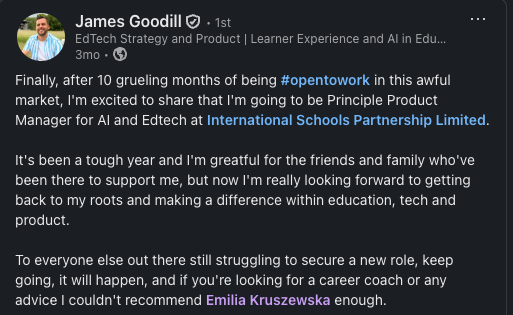
The strongest proof of recruitment work should come from the organisations and candidates who have experienced it.
This section should therefore use genuine RecruitHer feedback rather than generic claims.
A useful set of testimonials would show three different elements of the service.
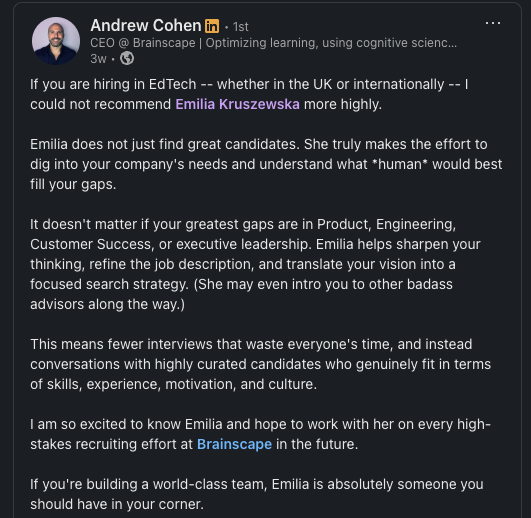
Specific testimonials are stronger than broad praise. A client explaining that RecruitHer understood an unusual brief, challenged the original requirements and introduced someone they would not otherwise have considered tells a much more useful story than simply saying the service was excellent.
An EdTech recruitment agency specialises in hiring for companies working across education technology, learning technology and related education markets. Sector understanding matters because the customers, buying processes, implementation challenges and skills required within EdTech can differ substantially from other technology sectors.
RecruitHer focuses particularly on commercial growth, customer and selected education related roles, including sales, customer success, implementation, partnerships, marketing, product related positions and leadership appointments. The exact search depends on the business problem and market.
No. Some roles genuinely require established education market knowledge, while others can benefit from talent coming from SaaS, education, publishing, training or another adjacent sector. We separate the skills that are essential on day one from those that can be learned.
Yes, where their experience matches the work. Education professionals can bring valuable skills into customer success, implementation, partnerships, training, product and commercial teams. The transition still needs to be assessed properly because education experience alone does not automatically qualify someone for every EdTech position.
Yes. The hiring profile changes significantly by company stage. Startups often need builders, scaleups need people who can make growth more repeatable, and established companies may need specialists or leaders who can operate within greater complexity while still contributing new thinking.
It begins by understanding the business need behind the vacancy. From there, we define the experience and behaviours that matter, assess the available talent market and agree the recruitment model and search strategy that best fit the appointment.
The best recruitment conversations do not begin with a list of keywords.
They begin with the company.
Its stage.
Its customers.
Its challenges.
And what needs to be different once the new person joins.
RecruitHer helps EdTech organisations make those connections between business strategy and talent.
Sometimes that means finding someone who already knows the market.
Sometimes it means introducing someone from a background the company had not initially considered.
And sometimes it means challenging the brief before searching for anybody at all.
Because filling a vacancy is useful.
Building the right team for what comes next is much more valuable.


